
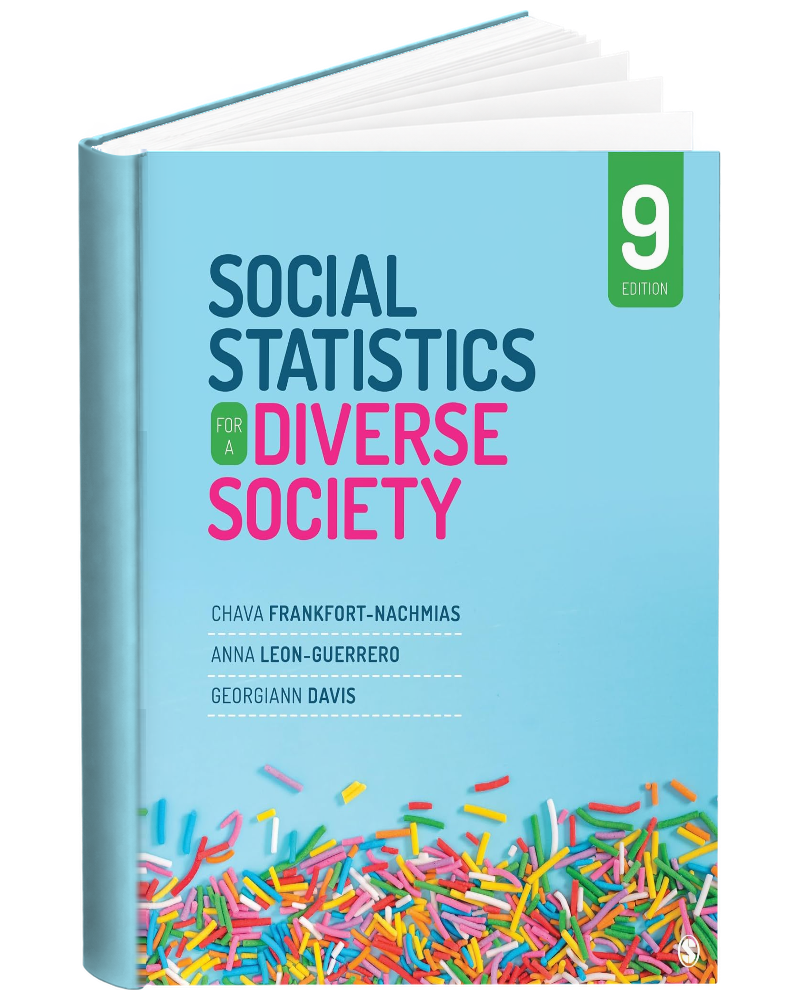
Social Statistics for a Diverse Society 9th Edition PDF by Chava Frankfort-Nachmias, Anna Leon-Guerrero & Georgiann Davis introduces statistical reasoning through substantive social-science questions and data about diverse populations. Chava Frankfort-Nachmias, Anna Leon-Guerrero, and Georgiann Davis use examples involving race, class, gender, and social inequality to make descriptive and inferential statistics meaningful while showing how statistical evidence is used to study society.
The ninth edition introduces statistical reasoning through examples drawn from diverse social populations and research questions. It covers descriptive statistics, probability, sampling, hypothesis testing, confidence intervals, analysis of variance, correlation, regression and interpretation of quantitative findings. The text is especially useful for sociology and social-science students who need to understand not only how to calculate statistics but how statistical choices shape conclusions about real social groups and inequalities.
Edition reference: Look up ISBN 9781544339733 in WorldCat.
About Social Statistics for a Diverse Society 9th Edition
The book progresses from the role of statistics in social research through organizing and graphing data, measures of central tendency and variability, the normal distribution, sampling, estimation, and hypothesis testing. It then develops bivariate tables, chi-square, measures of association, analysis of variance, correlation, and regression. Examples and exercises connect methods to real social issues, and software-oriented material supports the use of tools such as SPSS and Excel. The emphasis is not only on calculation but on interpreting results and understanding what statistical claims mean in social context.
This edition is useful for students who may be new to statistics because it consistently links procedures to questions about real social patterns. Instead of presenting formulas without context, the book shows what a statistic reveals, what assumptions are involved, and how results should be interpreted when studying diverse populations. Sociology, social work, criminal justice, and other social-science students can use it to build quantitative literacy for coursework and research, while the SPSS and Excel components help bridge hand calculations with software output.
The recurring attention to race, class, gender, and inequality also demonstrates how statistical choices influence conclusions about society.
Key Coverage & Sections Covered
- The role of statistics in social research
- Organizing, displaying, and describing data
- Measures of central tendency and variability
- Normal distributions and probability
- Sampling distributions and estimation
- Hypothesis testing and statistical significance
- Bivariate tables and chi-square analysis
- Measures of association
Who Uses This Book
- Sociology Students
- Social Science Students
- Social Work (BSW/MSW) Students
- Criminal Justice Students
- Public Policy Students
- Students Taking Introductory Statistics
- Research Methods Students
- Statistics Instructors
- Learners Analyzing Social Data
Also suitable for other healthcare professionals, academic instructors, and advanced learners who need an authoritative reference on Social Statistics for a Diverse Society linking core principles, diagnostic evaluation, and evidence-based practice.
PDF Edition Features & Access
- Digital Format: PDF eBook for reading in compatible PDF applications.
- Reading Tools: Available reading and annotation tools depend on your PDF application and the supplied file.
- Edition Verification: Check the title, edition and ISBN against your course syllabus or reading list.
Questions about access, payment or reading your eBook? Visit our FAQs.



Reviews
There are no reviews yet.